Fuji on the go

My family of cameras has expanded again. This time I’ve invested in a little sibling for my trusty compact system workhorse, the Fuji X-E1.

Little is the crucial world. The Fuji x100T has a fixed 23mm lens and is much lighter than its big brother. My regular camera takes up an entire backpack and doesn’t go with my everywhere.

One evening returning late from work, I got off the tram and was greeted with a stunning sunset pierced with cranes and high rises of urban Manchester. My phone camera is substandard at the best of times and couldn’t cope. I had to leave the sunset to melt away, uncaptured. 

I thought it was high time to have a decent camera to slip into my work bag and be ready for those moments. Fuji has greatly pleased me for nearly six years, so I turned to them and settled on an X100T. This was a cheaper option as it’s already been succeeded by the X100F but there’s still new stock to be had.

I expected a lot of familiarity and wasn’t disappointed, but things have moved on from my X-E1 and the menus and functions took some exploration. I also had trouble getting the electronic viewfinder properly calibrated so preview and finished shot matched up.

Teething troubles aside, working with this little one is fairly simple in my preferred manual mode. The aperture control on the lens can be a bit fiddly, as I’m more used to a chunky lens to adjust. The complete absence of zoom capability is at times an issue, but you have to adapt your photography.

But it’s a nifty little operator and the initial results prove that it has Fuji pedigree that I’ve grown to love a great deal, while having a camera close by much of the time is a huge advantage.

Click first image to view the gallery

Retro mono

It’s time for another sidestep into film photography. Some months ago my vintage Olympus-35 EC was loaded up with an Ilford HP5 400 black and white film. On various occasions it’s been slipped into my pocket and taken on walks around London and beyond.

Finally the roll came back from the developers, spiced with the old-fashioned magic of wondering what the results were – and not quite remembering taking some of them. At least this time there were no misfires or focusing disasters.

My first impression wasn’t as dazzling as the first colour film, which was rich and sparkling, defying all expectations for a 46-year-old camera. Unsurprisingly monochrome is far more subtle and creates an entirely different mood. The contrast is decent but benefited from a minimal, careful amount of post-processing. The grain appears strong and consistent, adding atmosphere and authenticity – far removed from the smoothness of digital.

Any impressions or thoughts will be much appreciated…


Click first image to view this set


Olympus-35 ECGallery entrance

Come closer

My Fuji family has just expanded with the addition of a new lens, the Fujifilm XF 18-135mm zoom. This sits aside the 18-55mm kit lens that came as standard with my Fuji X-E1 back in 2012, and the 60mm macro lens.

There is a comprehensive array of lenses for the Fuji compact system, with this zoom one of the more heavyweight offerings. Its substantially greater focal range offers the chance to bring distant objects and views closer, and hang back in street photography situations.

My first observations with this piece of glass is that it feels quite weighty attached to the light body of my camera. The instinct is to cradle it with one hand while carrying it around my neck. The manual zoom ring gives quite a lot of resistance, but it needs time to loosen up. Another practicality is that my camera bag has become heavier, there’s less space in it and will have to be replaced if the family expands any further.

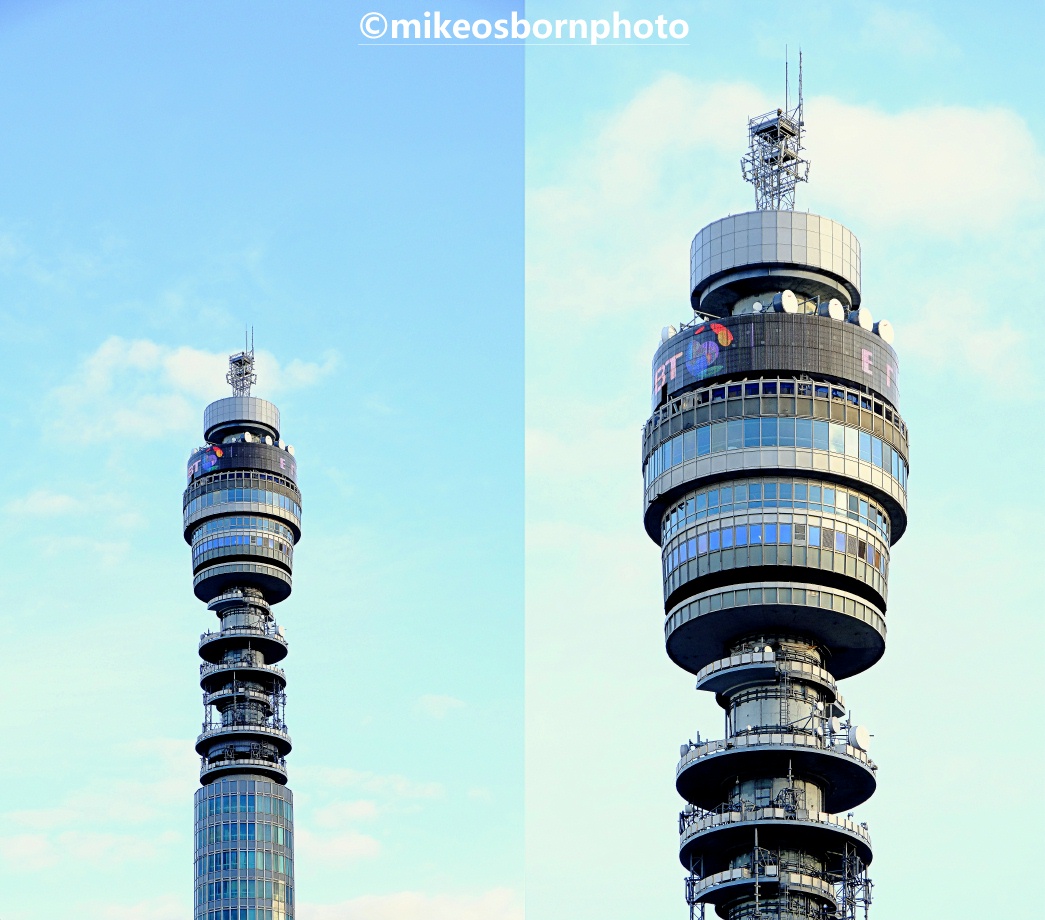
I went into central London and conducted a simple test using the BT Tower – a prominent city landmark – to prove the lens’ zooming prowess. The left-hand image (below) is at 55mm, the extent of my usual kit lens. The right-hand one was taken at the full 135mm, and the difference is obvious.

BT Tower

As a photographer who likes capturing tall structures and landscapes, this should be worth its weight in gold. Whether the 18-135mm lens will become my standard remains to be seen. And it’s weather resistant, but I have a phobia of exposing my camera to wet weather which is not likely to change. These are just initial impressions and a full review with technical specifications can be found on Ken Rockwell’s site.

The new joy of film

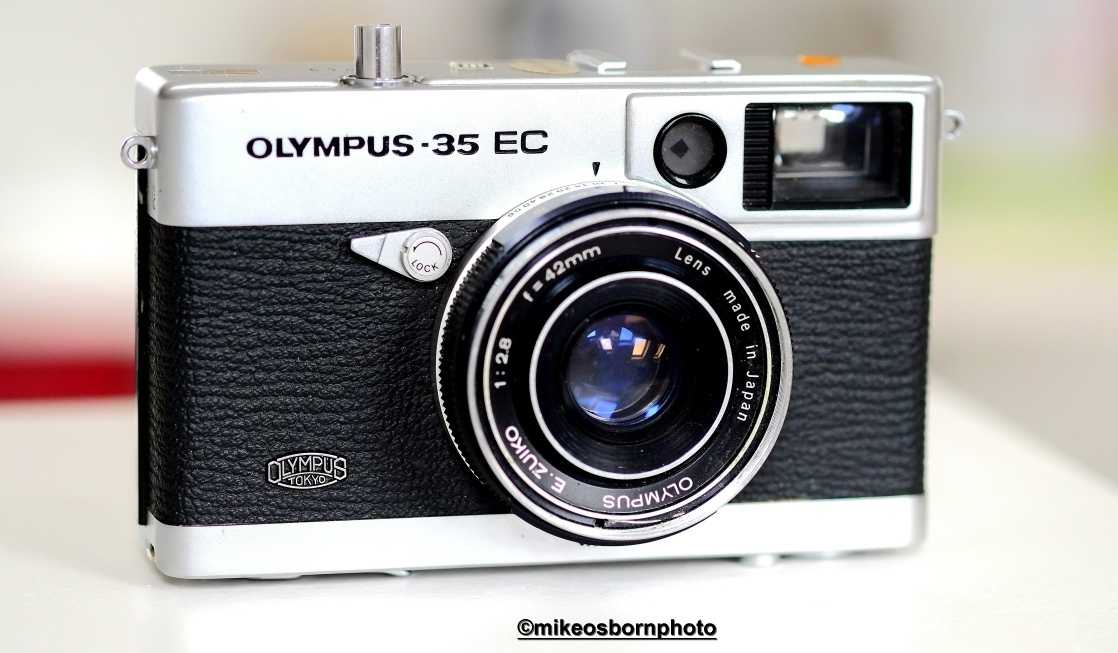
Olympus-35 ECI recently became the owner of an Olympus-35 EC, a compact film camera made in Japan around 1970. It’s close to pristine and its battery-powered components remain fully functional.

The proof of the pudding is in the shooting, however, so I quickly and easily loaded a Fuji ISO 400 colour film and went on my travels around west London with it tucked away in my pocket. Unloading the film was also slick and stress-free with this clever little gadget.

The first results have arrived after a trip to the developers. The bad news first – some close-ups I attempted were out of focus failures, simply beyond the range of the little Zuiko lens.

But that was the only downside. I’m impressed that a 45-year-old camera is still able to produce such clarity, depth and colour with that authentic granularity. Film definitely rivals digital on this evidence – and has its own magic too.


Click first image to view this selection

Gallery entrance

The Photo Shop


Japanese retro

Olympus-35 EC

My deep-rooted interest in film photography has taken flight again. Two years have passed since a 1968 Soviet Zenit took its place in my camera family, but its mechanical bulk and a slight fear of its needs have left it resting gracefully in a drawer.

A visit to The Photographers Gallery here in London set this new phase in motion. Their shop sells beautifully reconditioned Olympus Trips, a classic of its era. A bit of sage advice from Zorki Photo and a trawl around eBay resulted in the purchase of a well looked after Olympus 35 EC for £32.

Unlike my hulking Zenit, this is a 35mm compact in every sense. Its electronic shutter is powered by a couple of small batteries. Essentially a point and shoot, all you need to determine is the focus, divided into five zones.

Click first image to view the gallery

I’ve already loaded my new baby with a roll of Fuji Superia 400 colour film, a much more stress-free task than with the Zenit. A couple of test shots made it feel as simple as it was intended at the cusp of the 1970s, although there’s no pleasing mechanical shutter release thunk.

The only worry is that I’ll become frustrated over the lack of control with this little Olympus, preferring to operate my Fuji in manual mode at all times. But I already see it as a camera I can easily pop in my pocket and revive the joy of shooting film with – seeking out different light and colours and not knowing your results until they arrive in the post.


And yes, some shots may well eventually find their way onto that least analogue of mediums…

Instagram widget